

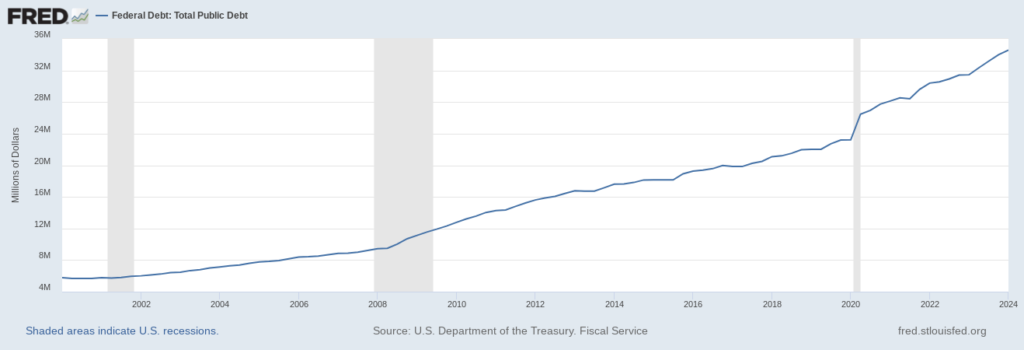
The 2024 presidential candidates have been floating new tax proposals to address the rapidly expanding federal debt. Former president Donald Trump has proposed imposing a tariff on foreign imports to help fund the government. Tariffs are usually favored by domestic manufacturers and labor unions because they increase the price of competitor’s products. However, there is a question of whether tariffs actually accomplish what their proponents claim.
A Case Study
Factory Man: How One Furniture Maker Battled Offshoring, Stayed Local –
and Helped Save an American Town gives an inside look at the furniture
business as seen by the Bassett family. Primarily focusing on the Bassett
family history in an around Virginia, the book touches upon complex issues
such as succession plans in a family business and anti-dumping laws.
Founding of a Company Town
The Bassett family’s role in the furniture industry started off indirectly with a
large acreage forest. The patriarch of the family, John David Bassett Sr.
convinced Norfolk and Western Railway to build a line through the land. John
opened a saw mill to produce wood for railroad ties and bridges. Over time,
the family business evolved to include making caskets and communion wine,
anything to make ends meet.
John took a trip to Grand Rapids, then the furniture capital of the U.S., in 1902
to sell lumber. During the trip, he decided that he could compete with these
furniture makers because he already had a ready source of lumber, and
wouldn’t have to pay freight for the lumber. He saw a competitive advantage, the only challenge was he didn’t know anything about furniture manufacturing. To address this shortcoming, John hired away employees from established furniture companies to make up for his inexperience. The family started out locally and established a large national presence over many decades. Here is an early indication that the furniture industry has a fairly narrow competitive moat, all that was needed to compete was some capital to buy equipment and hire some knowledgeable employees.
China Enters the Furniture Market
Chinese imports began to enter the U.S. furniture market in the 1980’s, with
prices 20 to 30% lower than comparable pieces made in the United States.
Much of the wood used in the Chinese furniture was shipped from the U.S.,
processed in China, and sent back to the U.S. for sale.
Although the freight costs were large, the wage gap between the two markets
was significant: Hourly wages for manual labor in China were ~$0.35,
whereas they were $5.25 in the U.S. The Chinese manufacturers also had
the advantage of not having to make a profit on their sales, as they were
willing to pay “tuition” to earn market share in the U.S.
At first, U.S. furniture firms were able to take advantage of the trend by
importing some or all of their products from China. However, retailers quickly discovered that they could buy directly from Chinese manufactures, cutting
out the middle man in the process. The move enabled retailers to improve their margins without raising prices. As a rule of thumb, furniture retailers typically mark up furniture 100% from their cost. Some furniture makers, such as Bassett, pivoted to opening their own retail locations and de-emphasized
furniture manufacturing.
Vaughan-Bassett, run by John Bassett III, tried to maintain manufacturing in
the U.S. by reducing labor, materials, and overhead costs. This included
smarter furniture design to minimize waste, and investment in new
equipment. The company was also able to reduce order processing times
from two weeks down to 30 minutes. Vaughan-Bassett also took advantage of their shorter supply chain to offer customers something that Chinese manufacturers couldn’t, offering deliveries a week after ordering and offering repair services. The fast delivery service enabled smaller furniture retailers to carry a minimal amount of inventory,enabling them to run their business with less working capital. This is a great example how companies operating in commodity businesses can use customer service as a competitive moat.
The consolidated supply chain almost wiped out Vaughan-Bassett in 1989 when their plant in Sumter was severely damaged by Hurricane Hugo. Fortunately for the business, they had insurance to cover the damages and the lost sales while the plant was rebuilt. Insuring the business against such a black swan event was prudent, and likely saved the business from failure.
The advantage of superior customer service began to slip and Vaughan-Bassett saw their revenues drop from $168 million in 2000 to $84 million in
2011 due to the onslaught of cheaper furniture being brought into the country. The company was willing to sell products at close to break-even in
order to keep their facility running, as it is cheaper to run full out versus having to idle the plant. However, the practice would not be sustainable, so they sought out a political solution.
Duties on Chinese Furniture
A group of U.S.-based furniture makers, led by John Bassett III, engaged
politicians to try to stop the flood of low cost furniture from China. The Byrd
Amendment enabled duties to be levied against companies that were viewed
as dumping goods in the U.S. market below cost. Over $369 million in duties were assessed on Chinese furniture manufacturers, with this money being directed to the impacted manufacturers. Vaughan-Bassett alone benefited from $21 million in Byrd payments in 2011.
The funds were used for a variety of purposes, including updating U.S. manufacturing facilities, dividends to shareholders, and worker compensation. Vaughan-Bassett also invested in an employee health clinic
that helped to rein in the cost of providing medical benefits for employees.
The duties were not entirely successful, as many Chinese manufacturers
simply shut down and started up under a new name, initiating a game of Wack-A-Mole.
The Byrd Amendment was repealed in 2006, but was replaced by ITC assessments. These policies had the effect of reducing Chinese furniture imports into the U.S. from $1.85 billion in 2006 to $538 million in 2013. The duties on Chinese goods shifted production to Indonesia and Vietnam; monthly wages for a factory worker in Indonesia were around $200/month in 2014. The other consequence was higher costs for U.S. consumers. Gary Hufbauer of the Peterson Institute estimated that every $800,000 in duties saved only one U.S. factory job. Indeed, furniture manufacturing payrolls in the U.S. continued to decline during this time. Vaughan-Bassett and others who pushed for duties were frequently boycotted by furniture retailers who
resented having their supply of low-cost Chinese goods curtailed by duties.
Conclusions
The book demonstrates capitalism’s relentless drive to reduce production costs. The furniture manufacturing industry in the United States has been evolving for over 100 years, with production transitioning through Grand Rapids, Virginia, China, and now to Indonesia and Vietnam to generate the lowest overall production cost. Companies that were not willing to adapt
did not survive, while Vaughan-Bassett and others that were willing to evolve
survived, although in a smaller form that had to focus on factors other than cost, such as customer service or custom work.
Tariffs only temporarily slowed down the inevitable decline of mass furniture production in the U.S and drove up consumer costs in the process, essentially creating an indirect tax on individuals. Further, history has shown that tariffs beget retaliatory tariffs by other countries, resulting in further damage to the domestic manufacturing sector as exports are curtailed by higher prices. For example, the EU imposed higher tariffs on U.S.-produced whiskey in 2018 in response to U.S. tariffs on aluminum and steel. Tariffs are an impractical way to promote domestic manufacturing and alternatives such as investments in automation and simplification of regulations should be considered.
Leave a Reply