

In the last post, we looked at the importance of investing in high quality businesses with durable returns on capital. In that post, we mentioned not needing to depend on valuation changes to make a bundle of money over your investment lifetime. You do hope to buy companies at low valuations, but you do not need the valuation for the company to ever become high in order to make money. As you invest saved money, as you receive dividends that must be reinvested, and as the company repurchases shares increasing your ownership and share of the profits, you hope that all of these events can be done at low valuation. In the real world, you rarely invest everything upfront. Instead, you have a constant process of reinvestment (and share buybacks) that occurs over the years and decades, and you hope that valuations will stay low in the most desirable businesses, so that you can continue to reinvest.
To illustrate this, I have made a study of 3 example companies. You have only $10,000 to invest in each company, and you choose to re-invest all dividends that you receive back into the company. Each of the 3 companies makes $15 million per year in profits, and is in an industry that does not grow and has no capital requirements, so they return the entire $15 million to shareholders each year. The earnings for each company is of a very high quality and never varies, nor is it expected to change from year to year. For company A, you can purchase at the extremely low price to earnings ratio of 2 (P/E = 2). This valuation never changes over the entire study – that is, the company is perpetually undervalued. Therefore you can reinvest forever at this low valuation. For company B, the P/E is 12, a more reasonable, if not still somewhat undervalued number. This valuation also never changes over the entire study. Lastly, for company C, the valuation changes immediately after you purchase from a P/E of 12 to a more richly valued P/E of 24. What are the results? Take a look at Figures 1 and 2 below. Figure 1 shows your cumulative earnings over the entire holding period for each company. It includes the dividends you receive, as well as compounding that occurs from reinvesting the dividends back into each company.
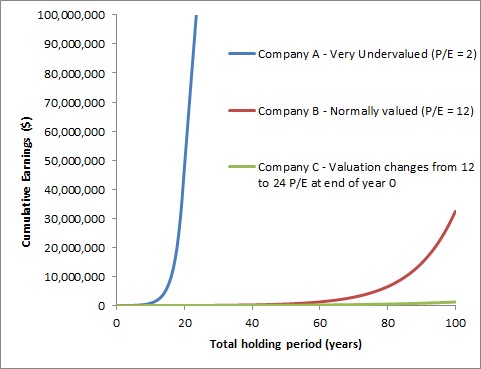
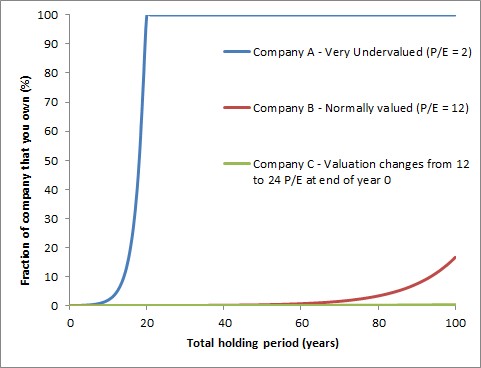
As you notice, if the company stays perpetually and ridiculously undervalued (company A with a P/E of 2), your earnings very quickly grow and your reinvestment becomes so large that you own the entire company ($30 million market cap) after only just shy of 20 years. From that point you cannot own more than 100% of the company so your earnings level off at a cool $15 million per year. After 20 years your cumulative earnings on the company are over $48 million and growing. Wow. No valuation adjustment needed, and your $10,000 grew at a crazy fast rate over just 2 decades. In reality, this situation is unlikely to persist until you can own 100% of the company because some owners will refuse to sell such a gem, and then the price you pay will need to rise in order to get them to part with their ownership stake so that you can purchase more of the company.
Now let’s see what happens with reinvestment if the company is a more reasonably valued P/E of 12. After 20 years, you own 0.03% of the company, and after 100 years you would own 16.6%. Quite a difference. Your cumulative earnings after 20 years would be $43,700, and your $10,000 investment would now be worth $53,700. This slightly greater than 5X increase is nowhere near the 4800X increase of you would see if you had invested in company A.
Finally, let’s see what happens if you invest in company C where immediately after you invest, the P/E doubles from 12 to 24. Immediately after you invest, your $10,000 becomes $20,000 and you congratulate yourself on your brilliant timing, doubling your money instantly! What happens after 20 years, though? After 20 years, you own 0.01% of the company, and your investment is now worth $49,000 dollars. After 100 years you would own 0.34% of the company. What gives? With company C, your investment is actually worth less than in the case of investment with company B despite the quick doubling of your investment with company C. The key here is that you must re-invest, and if you re-invest at higher valuations, then your money will grow more slowly. This trumps the immediate doubling of your investment after a while.
This is why you hope for investments to stay undervalued for long periods of time, so that you can reinvest at favorable valuations. You will always need to reinvest over your investing lifetime – whether that is through dividends, putting new savings to work in the market, or if it is done on your behalf by the company buying back shares. You do not need valuations to go back to normal or become overvalued to make lots of money. I should note, it is theoretically possible that you could make enormous sums of money if you can reliably choose a long sequence of investments that change in valuation each time you make a purchase, but this idea is starting to sound an awful lot like timing investments or timing the market. And we know that this doesn’t work in any reliable way.
Note that the companies above don’t grow at all. Their earnings are always a stable $15 million year after year. You don’t even need the company to grow to compound your investment at a fantastic rate! You just need constant investment available at favorable valuations.
These examples above focused on reinvestment in a single company for simplicity, but the same applies for reinvestment across the investing universe. If the company you have invested in is no longer the best value, take your dividends from that company and reinvest them in the newest and best combination of value / high quality from your Star List of outstanding companies. If you already have a full allocation of funds invested in the first company on your list, move down the list to the next best opportunity for investment. Do not focus on trying to pick something that will shoot up in price tomorrow. Focus on trying to buy the most earnings or cash flow at the highest quality for the least amount of money. If you do this continually, your investment gains will compound faster.
Here is where a little bit of art comes into play for choosing the next investment. You will always find opportunities from your Star List to invest in. Whether the market is overvalued or undervalued, there will always be, independent of this, companies trading at interesting or terrible valuations in the market. You will usually have several attractive investments to choose from on your list, so which do you choose for the next purchase? There is a lot that goes into the choice, from diversification considerations, to tax considerations, and more. But all else being equal, if 2 companies only display a small to moderate amount of difference in valuation, I would choose the higher quality business over the lower quality one (in terms of return on capital, earnings quality, financial stability, etc.), even if it is a bit more richly valued. This is what Warren Buffett is describing when he says, “I would rather own a great company at a good price, than a good company at a great price.”
Now that we have explored why we look at quality businesses, why we hope to invest at favorable valuations, and why we don’t worry about timing the market or whether the valuation of the company will change over time, we are going to focus in the next post on how we start to analyze companies of high quality to put onto our Star List for potential future investment.
Leave a Reply